The cards people keep are the ones that catch the light or can be felt. A plain-English guide to spot UV, foiling, embossing, debossing and rounded corners.
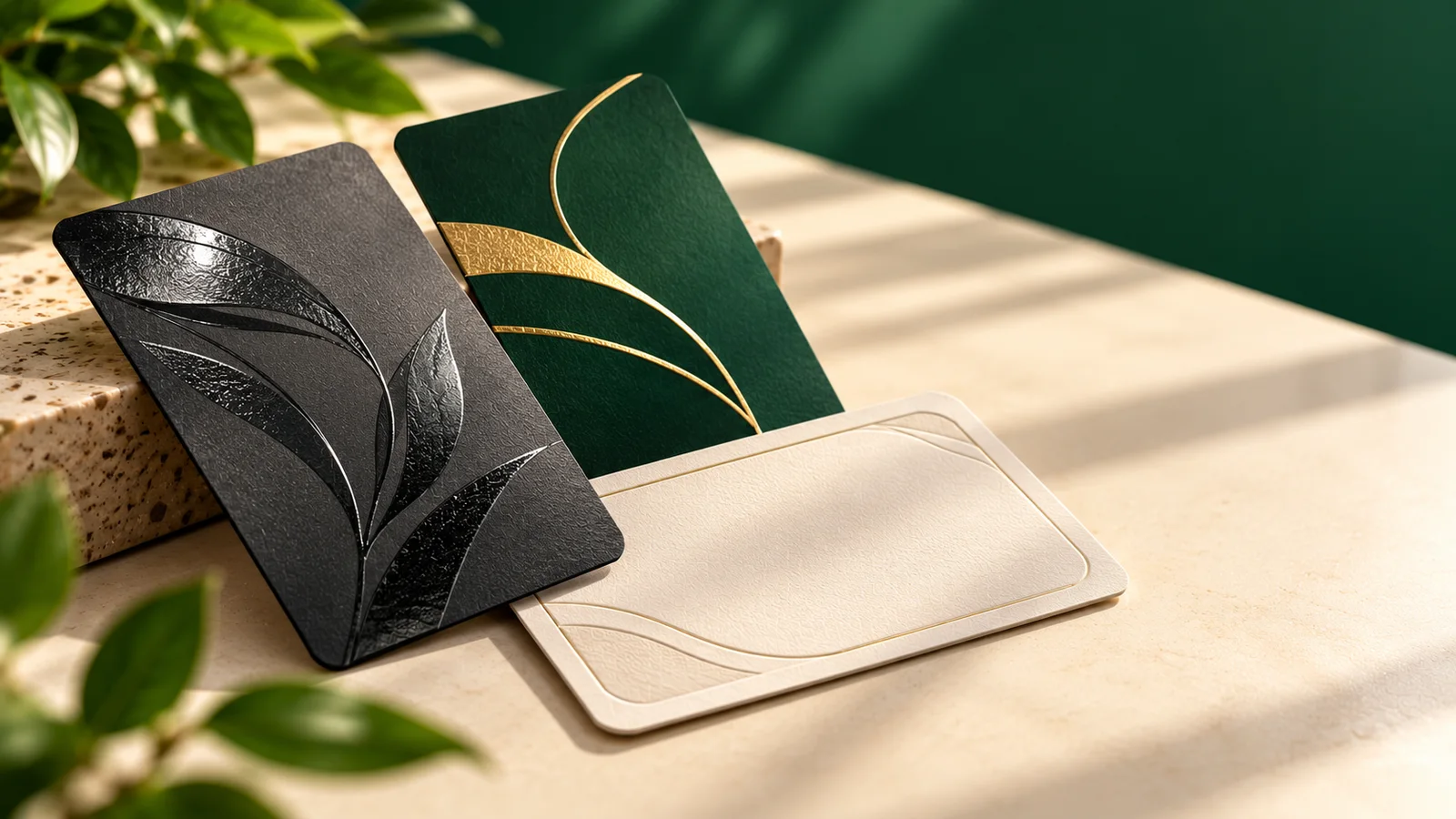
Think back to the last networking event you went to. You probably came home with a pocket full of cards. A week later, how many could you picture? Maybe one or two. And we'd bet those weren't the ones with the cleverest tagline. They were the ones that did something: a logo that flashed when you tilted it, a name you could feel under your thumb, a corner that was soft instead of sharp.
That "something" is a special finish. People assume they're only for luxury brands with big budgets. They're not. Here's what each one does, what it costs you in preparation, and when it's honestly worth it.
A normal card is printed and trimmed. A special finish adds one more step on top: a coating, a metallic layer, a pressed texture or a different cut. UV and foil play with light. Embossing and debossing play with touch. Rounded corners change the shape in your hand. On our UV business cards you can add spot UV, foiling, embossing and rounded corners, all on firm 300 or 350 GSM art card.
UV coating is a liquid varnish that's cured instantly with ultraviolet light. It leaves a hard, glossy layer that makes colours look deeper and protects the print.
With full UV, the whole card gets that shine. It's great for photo-led designs and loud brand colours.
Spot UV is where it gets interesting. The varnish goes only on the parts you pick, say your logo or a pattern, while the rest of the card stays matte. Hold it flat and it looks calm and elegant. Tilt it and the logo suddenly flashes. We've watched customers do that tilt three or four times in a row the first time they see their proof sample.
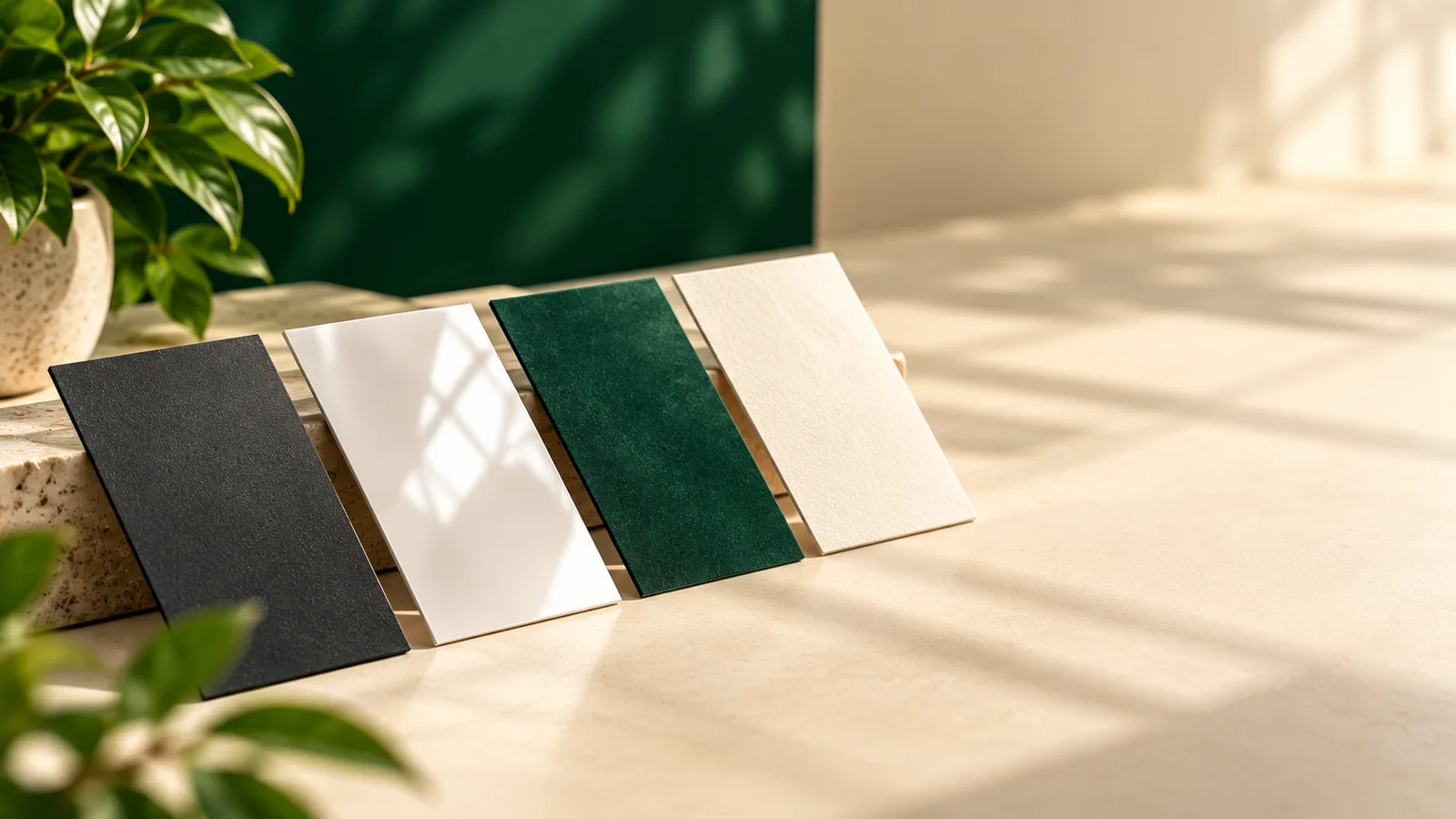
The magic is contrast. A glossy logo on a glossy card disappears. A glossy logo on matte black or deep navy pops. That's why spot UV is almost always paired with a matte base.
You'll send two files that line up perfectly. The first is your normal artwork at 92 by 54mm, including 1.5mm bleed, in CMYK. The second is the UV mask: a separate vector PDF of the same size where everything that should shine is filled 100% black and everything else is white.
Keep the UV shapes bold. Details thinner than roughly 1mm may not come out cleanly. If your logo has delicate strokes, put the UV on a simplified version of it, or on a background pattern instead. Your designer will know exactly what this means if you forward them this paragraph.
Normal printing ink can't make true metallic gold or silver. It can only fake it with yellowish browns and greys. Foiling uses heat to press a thin metallic film onto the card, so the shine is real.
Gold foil feels right for law firms, jewellers, wedding planners and anyone with a classic brand. Silver and rose tones feel more modern, and we see them a lot with tech founders and fashion labels. Foil looks best on clean, solid shapes: a monogram, a name, a thin border. Like spot UV, it needs its own vector layer marking exactly where it goes.
Embossing pushes part of the card up so your design stands slightly raised. Debossing presses it down so the design sits just below the surface. Both make people run their thumb over the card, which is precisely the point. A card that gets touched gets remembered.
Embossing feels confident and pairs beautifully with foil on a monogram. Debossing is quieter and more crafted, and it looks especially good on thick, uncoated card. Both are available on our standard business cards, and embossing can be combined with spot UV and foil on UV cards.
This is the cheapest upgrade and still one of the most noticeable. Rounded corners make a card feel friendlier, and they stop the corners fraying in a wallet. Wellness brands, kids' businesses, cafes and creative studios use them a lot.
| Finish | What it does | Looks best on | Popular with |
|---|---|---|---|
| Spot UV | Glossy highlights on matte | Bold logos, patterns | Salons, startups, real estate |
| Full UV | All-over shine and protection | Photos, bright colours | Restaurants, photographers |
| Foiling | Real metallic shine | Monograms, borders | Law firms, jewellers, weddings |
| Embossing | Raised, touchable design | Logos, initials | Premium services |
| Rounded corners | Softer shape | Any design | Wellness, kids, cafes |
One finish is elegant. Two can be striking. Three usually turns into noise. Our favourite combinations are spot UV on matte black with rounded corners, and a gold foil monogram with embossing on thick ivory card. Pick one hero effect, keep the rest of the design simple, and leave enough empty space for the finish to breathe.
High-gloss UV shows fingerprints more than matte, so handle cards by the edges. Keep them flat in a card case, don't stack heavy things on them for the first day after they arrive, and keep them out of strong sunlight for long periods, which can slowly yellow a UV layer. A microfibre cloth takes care of smudges.
Think in conversations, not cards. Our UV business cards start from Rs. 1175, against Rs. 750 for standard ones. If that difference helps you land even one good meeting, it has paid for itself many times over. For founders, senior consultants and premium retailers, whose card is often the first thing a client touches, it's an easy call.
Ready to try it? Choose the one element you want people to notice, decide whether it should shine or be felt, and prepare a clean mask file for it. Then build your card on our UV business cards page. You'll see a digital proof before anything is printed.