From garba passes to school house badges and campaign pins, custom badges are small, cheap and surprisingly effective. Here's how to choose size, shape and finish.
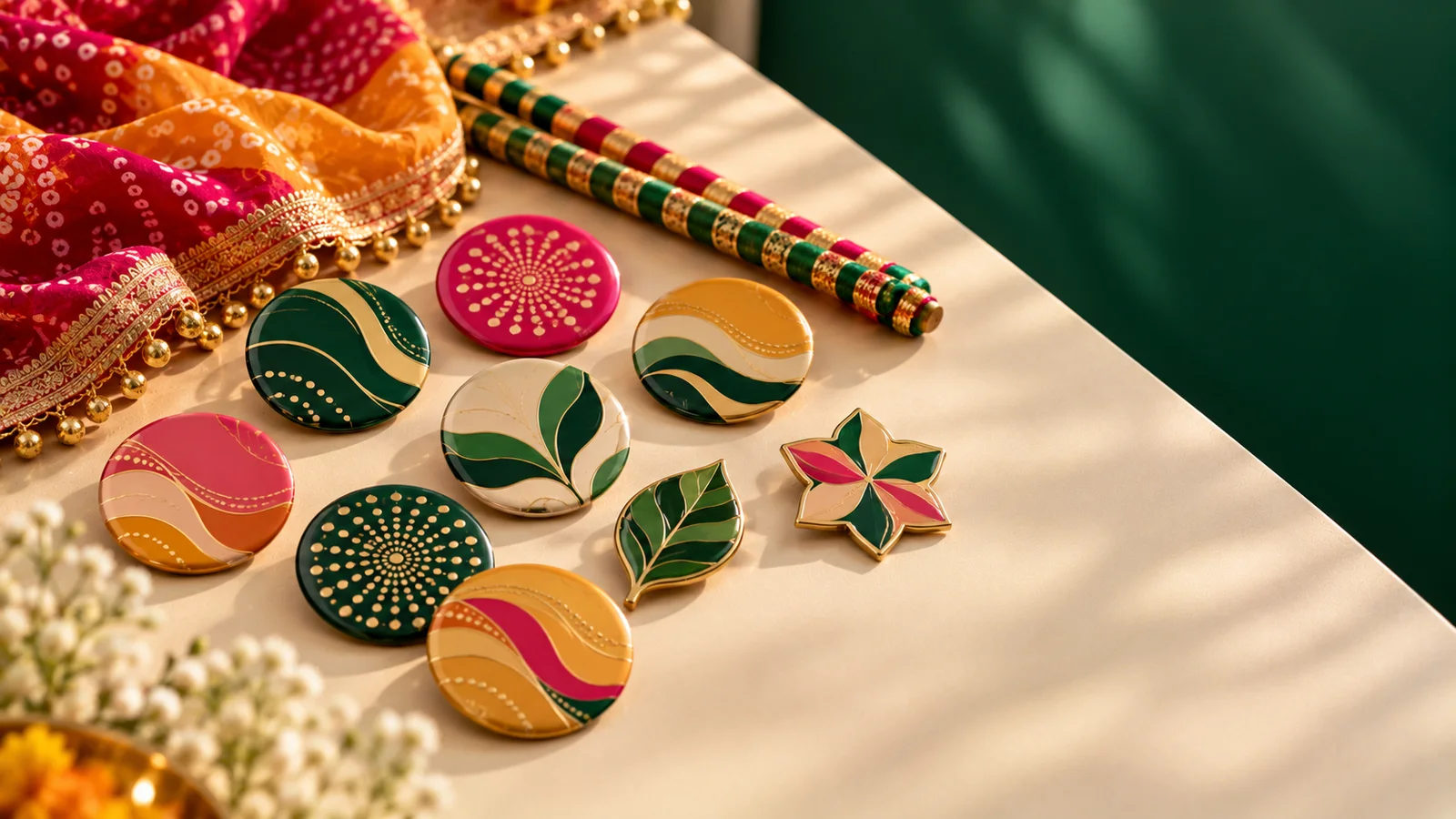
Every Navratri, our badge orders jump, and it's easy to see why. Garba organisers use them as entry passes. Societies hand them out to volunteers so everyone knows who to ask. Friends' groups make matching badges for the whole gang. And after the nine nights are over, a surprising number of those badges end up pinned to a bag or a jacket, still being worn months later.
Badges are like that. They're small, they're inexpensive, and they do a surprising amount of work, whether that's identifying staff at an event, building school spirit or spreading a campaign. Here's what to know before you order.
Our badges are metal badges with a printed full-colour insert. You can have them printed on the front only, or front and back, and add optional lamination for extra durability. They come with a safety pin back as standard, and magnetic backs or clips can be arranged on request. Magnetic backs are worth considering for silk, chiffon and other delicate fabrics, since they don't leave pin holes, which matters a lot when people are wearing their best chaniya choli.
Circular badges are the classic button badge, and they're what most people picture. Standard diameters are 25, 32, 44, 58 and 75mm. A 25 or 32mm badge is subtle, good for staff identification or a small logo pin. 44mm is the all-rounder, big enough for a design and a short line of text. 58 and 75mm are statement sizes, the ones you can read from across a room, perfect for "Volunteer" or "Ask Me" badges at events.
Custom-shape badges are cut to any outline you give us: your logo, a mascot, a star, a diya, a pair of dandiya sticks. They stand out instantly because they don't look like every other badge in the room. They're lovely for brand merchandise, college fests and limited-edition giveaways.
Garba and festival nights. As passes, volunteer identifiers or simply souvenirs. Colour-coding works well here: one colour for organisers, one for security, one for first aid.
Schools. House badges, prefect and captain badges, "Star of the Week" badges, and badges for annual day and sports day. Children treasure these far more than adults expect.
College fests and clubs. Team badges, fest merchandise, and badges for organising committees, which often become a little badge of honour in themselves.
Corporate events and conferences. Staff and speaker identification, brand pins for launches, and awareness campaigns inside offices.
Campaigns and causes. Awareness drives, NGO events and community campaigns, where a badge lets supporters show they're part of something.
The golden rule: bold and simple. A badge is seen from a metre or two away, often while someone is moving. A strong colour, a clear icon and two or three words will always beat a detailed illustration with a paragraph of text.
There's one technical thing that catches people out. When a badge is assembled, the printed insert wraps around the curved edge of the metal. So keep all important content at least 3mm inside the cut edge, or it will disappear around the side. For circular badges, design in a circle matching the badge diameter with 2mm bleed. For custom shapes, supply a die-line on its own layer showing the exact outline. Use 300 DPI artwork and CMYK colours, and make sure the design is sharp, because small badges show every blurry pixel.
Most people never think about the back of a badge, but it's useful space. For event passes, you can print the date, the venue or an emergency contact number on the back, so volunteers always have it with them. Schools sometimes print the academic year on the back of house badges, which turns them into little keepsakes. Brands use the back for a website or social handle. If you choose front and back printing, keep the back simple and readable, since it's mostly glanced at when someone flips the badge over.
For events, count your attendees or team members and add a buffer of around ten percent for lost badges, last-minute volunteers and the people who want a spare for a friend. For schools, order by house or class and keep a few extras of each for new admissions during the year.
If the badges are for an outdoor event, a long festival, or anything that will be handled a lot, choose lamination. Laminated badges resist rain and sunlight, and they can be wiped clean with a damp cloth. For a short indoor event, unlaminated badges are perfectly fine and keep the cost down.
Attach pin badges carefully to avoid snagging delicate fabrics. Don't bend or flex a badge, because that can crack the printed surface. If you're storing spares, keep them in a padded box so the pins don't scratch other badges. Small things, but they keep a batch looking new for the next event.
Festival weeks are busy for everyone, so the best advice we can give is to finalise your design early. Collect logos, decide on colours and sizes, and approve your proof in good time. That way you're sorting out dandiya sticks and outfits in the last week, not badge artwork.
Our badges start from Rs. 208, depending on size, shape, printing sides, lamination and quantity. For something that identifies your team, promotes your brand and often becomes a keepsake, that's excellent value.
Whether it's a garba night, a school function or a campaign launch, pick a size people can read, keep the design bold, and choose the right back for the fabric. You can set yours up on our custom badges page, and we'll send a proof before anything is made.